W0PHP QSL Card Generator
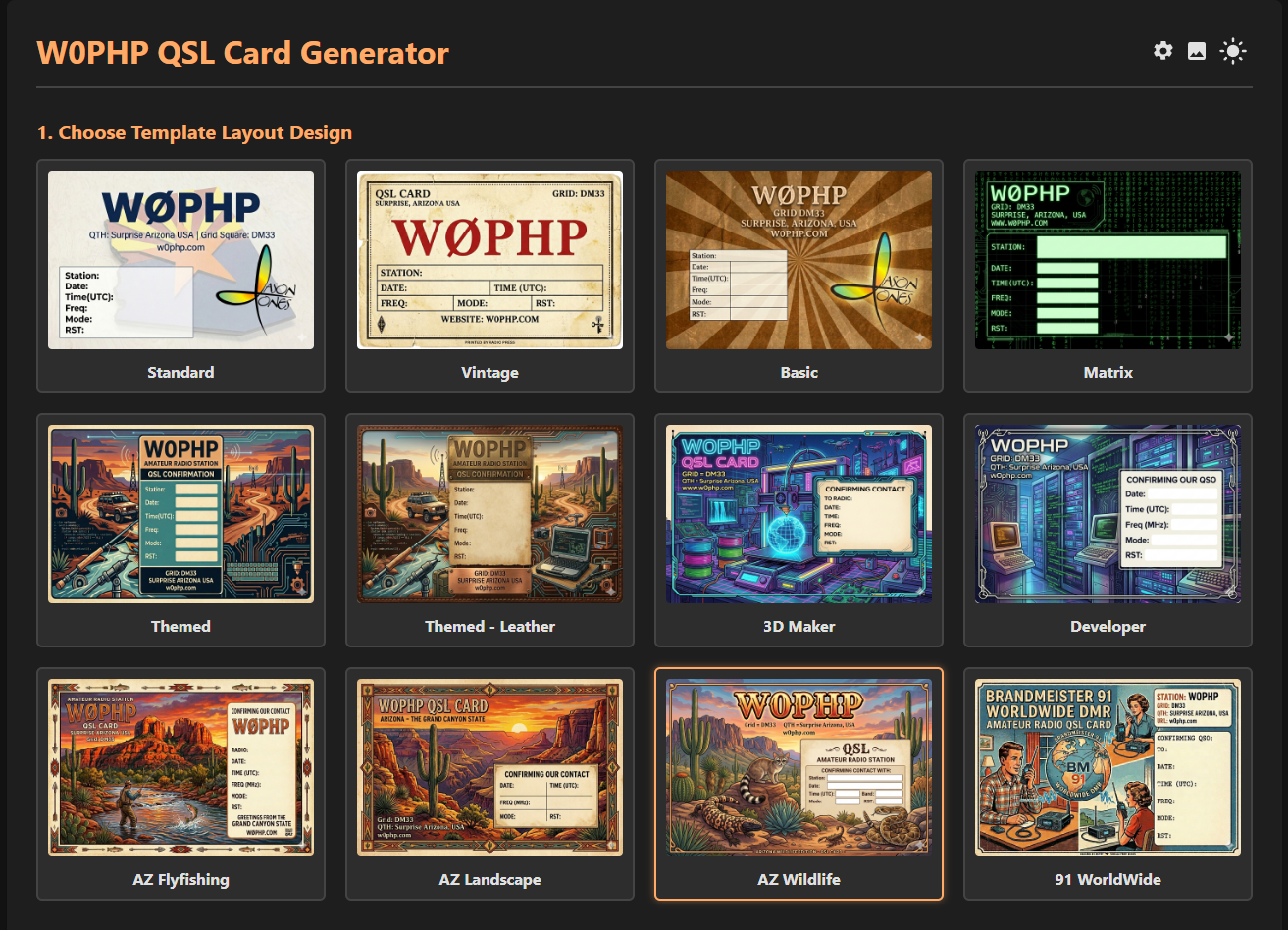
Exchanging QSL cards is one of amateur radio’s oldest and most rewarding traditions, confirming physical contacts (QSOs) across the globe. However, manually designing cards or managing separate software layouts for every operator configuration can quickly become tedious. To streamline this process, I developed the W0PHP QSL Card Generator—a completely lightweight, browser-based tool that automates the generation of professional, print-ready confirmation cards.
Operating entirely from a clean, responsive front-end interface, the generator allows operators to inputs their contact metadata—such as callsign, signal reports (RST), operating frequency, signal mode, and date/time configurations—and instantly maps it into a standardized layout. The system is designed from the ground up to output precision files ready for direct printing or digital archiving.
Core Application Architecture & Capabilities
The primary directive of the application is removing the dependency on desktop layout editors or complex design software. Its design logic encompasses several features focused on end-user workflow efficiency:
- Dynamic Real-Time Canvas Rendering: Operators see their layout adapt instantly to character input, matching typeface boundaries and structural fields perfectly.
- Standardized Printing Formats: Outputs high-resolution layouts tailored to standard indexing and postcards dimensions used universally within international QSL bureaus.
- Modular Data Formatting: Includes swift fields handling UTC time conversion, global grid square calculations, and variable operational modes (SSB, CW, FT8, DMR).
Technical Hurdles & Development Insights
While the frontend interface relies heavily on a responsive **Bootstrap 5** container grid for user configuration fields, managing the synchronization of layout metadata to an immutable pixel space presented unique programmatic challenges.
During the core development cycle, a significant hurdle emerged around text element rendering boundaries. To allow fluid real-time user manipulation without triggering constant server-side processing overhead, the generation logic uses an optimized asynchronous pipeline. The interface tracks change events across input arrays via optimized **JavaScript** handlers, updating an interactive layout object mapping coordinates onto a target bounding rectangle.
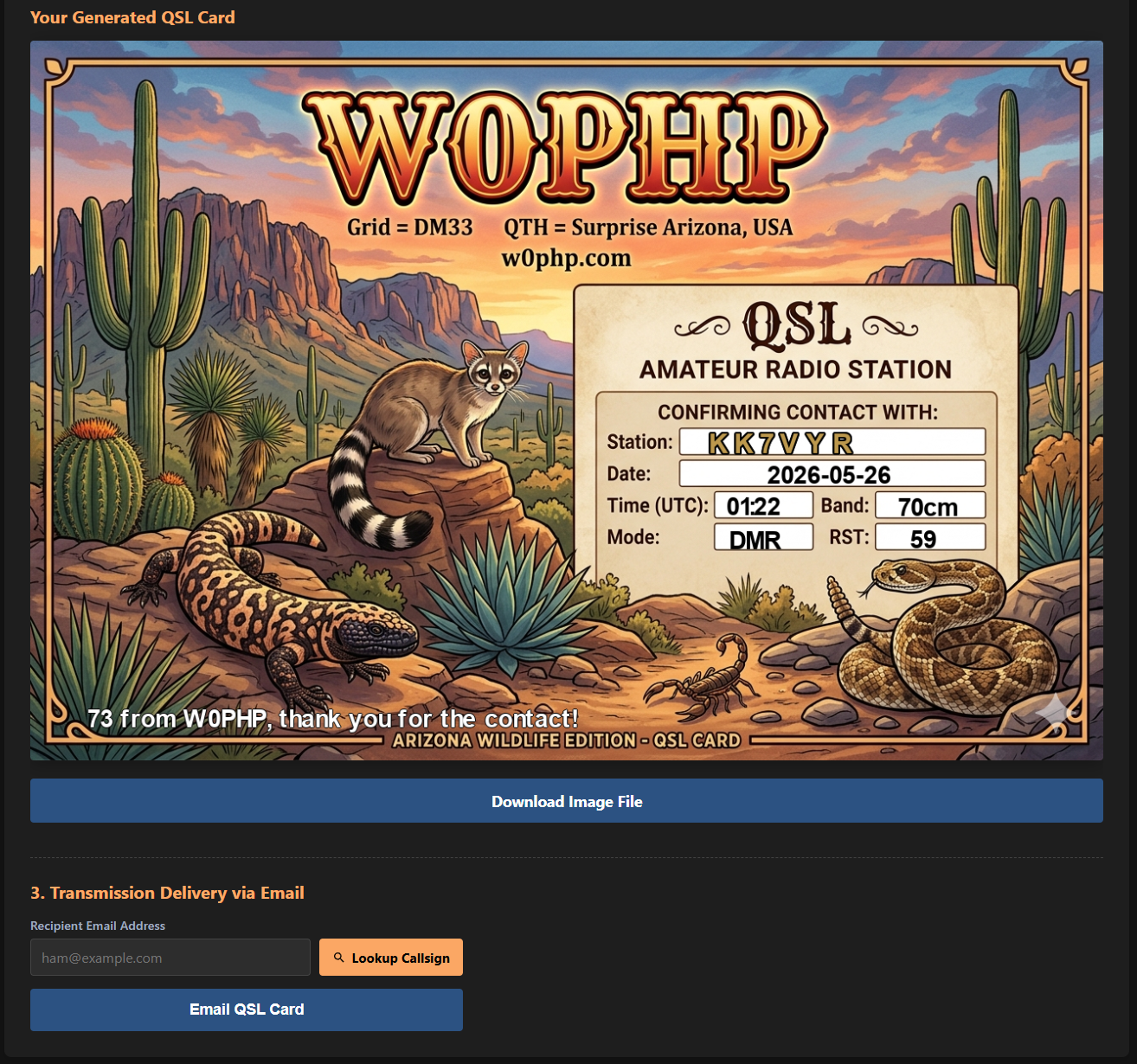 Sample high-resolution front design output
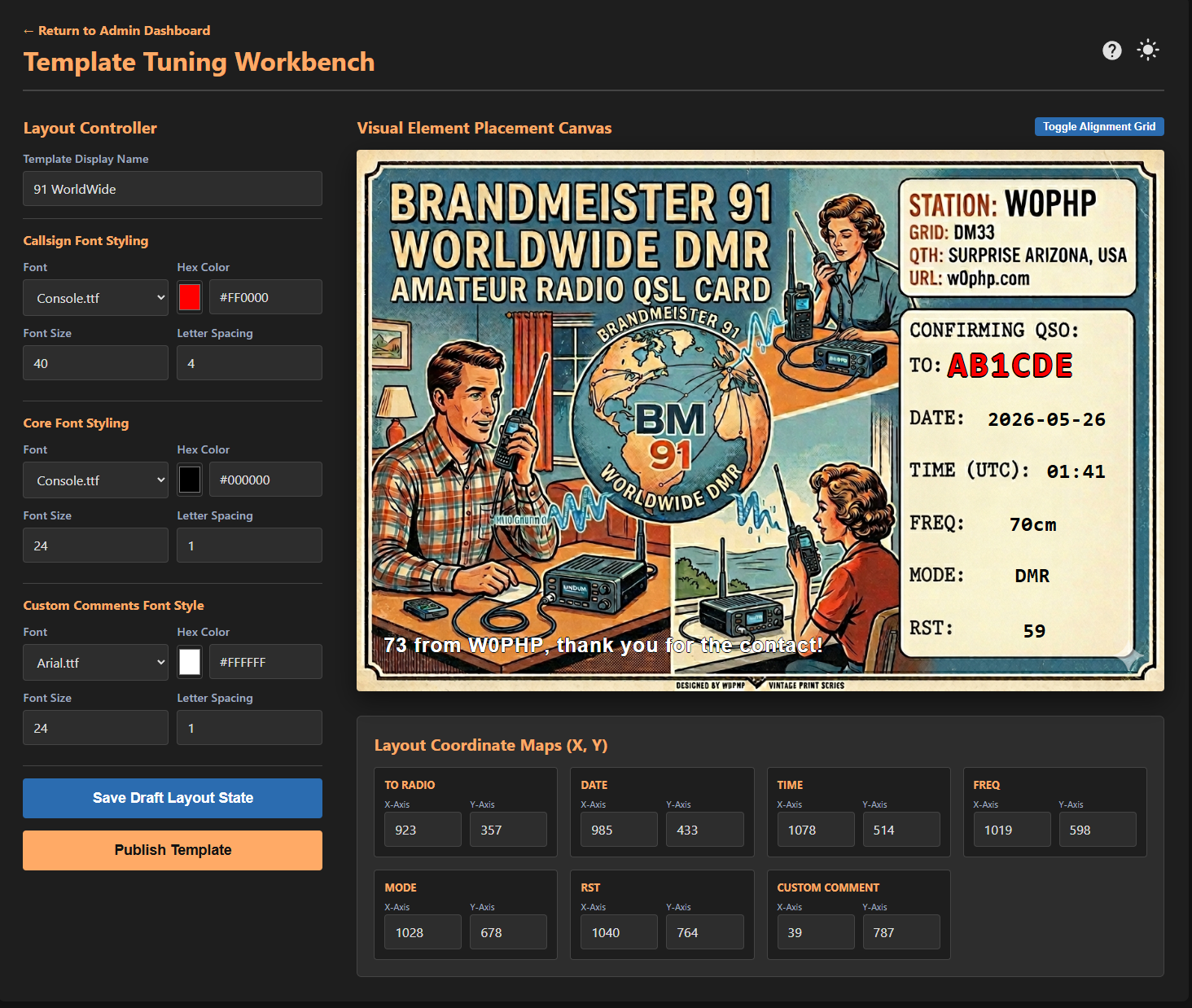 Automated grid matrix logging data fields on card back
Once the layout adjustments are satisfied client-side, the vector specifications pass securely to the **PHP** backbone. Utilizing the server's GD and image manipulation libraries, the backend programmatically constructs high-density, target-safe boundaries. This ensures that any user-uploaded image assets or high-contrast textual overlays remain crisp, avoiding pixelation down the line during industrial CMYK print cycles.
Furthermore, strict sanitization protocols were built across the application to handle data tracking seamlessly. Since ham radio callsigns vary across structural standards globally (containing numeric modifiers, special country prefixes, and portable designations like W0PHP/P), text handling logic was strictly calibrated to prevent text wrapper clipping or font scaling collisions on the generated templates.
Deployment Environment
The tool is completely standalone, running smoothly across all standard environments without heavy client dependencies or local database scaling bottlenecks.